Navigation

This photo-blog is designed to work either as a standard blog with images or - by clicking any image - a photo-album. To see an image in full resolution click to the left or right of an image in blog mode.
Showing posts with label San Cristobal de las Casas. Show all posts

Monday, July 12, 2010

San Cristobal to Oaxaca City

The view back of San Cristobal as we leave

This is another overland blog illustrating the changing scenery as we cross southern Mexico from San Cristobal to Oaxaca City with an overnight stopover in Tehuantepec, a small town on the highway on coastal Oaxaca state which splits the travel time neatly into two successive five and a half hour journeys. I have included a good number of scenes to try to get the feel of the best sites on a long distance travel journey.
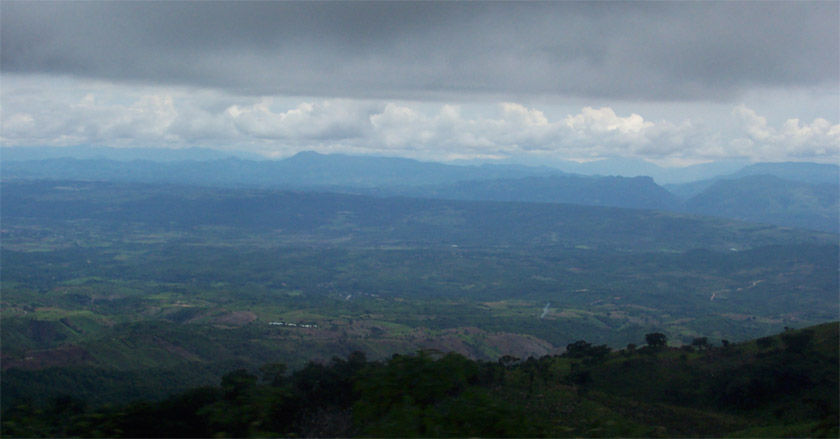
The road descends from a very high plateau overlooking the surrounding country for miles

We started out from San Cristobal at a high altitude and after half an hour emerge from the highlands descending with vast sweeping views of the surrounding regions of Mexico, slowly descending into the valley of Tuxtla.


As we descend we can see Tuxtla 40 km before we arrive

We could see Tuxtla in the distance 40 kms and over half an hour before we arrived.

Tuxtla from the highway

Tuxtla was very much a commercial Mexican city with a huge presence of Californian hypermarkets and industrial and shopping centres around the periphery. We simply waited 20 minutes for the next bus connection to Tehuantepec.

Distant views of the sea or a lake as we descend from a second high pass


The road descended further until it came to a hot lowland plain with views out to the left which looked like a bay of the ocean but could have been a coastal lake.

Hotel Oasis in Tehuantepec a small town of some 30,000 people

We stayed the night in hot little Tehuantepec a town with only one cheap hotel, which the guy on the desk tried to insist would be 480 although he had a mid range room for 300 Pesos as the proprietor had said by e-mail, only up four flights of stairs, which Christine had to drag the luggage up ending in near exhaustion.

The hotel had a courtyard consisting of one four storey tree

We had arrived at 8.30. By the time we got down to the little restaurant next door it was 9.30 and we then had to wait till 10.16 for them to serve omelette and French fries. The night was hot and humid so we had to sleep naked with barely half a sheet and we were still sweating.

A panorama from the roof of the Oasis (click to enlarge)

The little fly-ridden Tehuantepec market with women swatting their wares

When Christine went out in the morning to get mile for cafe con leche the woman she asked directions from warned her that she could get robbed, but nothing eventueated.

Five scenes from around the town square

Before we left I took a kstroll around the town square to get a glimpse of life in a small out of the way Mexican town on the road.


The town square


One nice thing about Latin America is the fact that women are happy to breast feed in public without feeling shy or inhibited.


The church on the way out to the bus station on the highway

Street scenes on the outskirts

A one horse cowboy with food to travel long distances

A Tehuantepec bario as we leave
Scenes of the distant high country we will again enter

The next days journey again climbed high passes through rolling highland country which seems to keep Mexico folded up into a creased tortuous landscape wherever you go.


A lake we passed by on the lowlands

Climbing again into more arid country

Back into rolling highlands with distant overviews

The scenery was gradually changing from lush to semi-arid interspersed with San Pedro-like cacti, some of which grew in great tree-like clumps.


View over the plants used to ferment Mezcal

The country continues traverse high passes with stunning distant views


Two views over rural Mexican settlements


The terrain has become more arid and full of tall trichocereus cacti


Eventually after another five and a half hours of travel we descended out of the last high pass into the central valley of Oaxaca and along the straight highway leading from the ruins at Mitla to Oaxaca City itself, passing several of the famous artisan villages along the way.

Coming down towards the central valley of Oaxaca

One of the villages on the outskirts in the distance

Arrival in Oaxaca City

Saturday, July 10, 2010

San Cristobal and San Juan Chamula

A water seller pushes his trike under heavy afternoon clouds

San Cristobal centro has been an interesting experience and a place of contrasts. The city is colourful and richly decorated in traditional themes, and also rich with a variety of Tribal peoples of Chiapas also in the city trying to eke a living, although it is a city full of inconsistencies.

There is an unrelenting contrast between rich people driving gas guzzling rancheros and the poverty of street people accentuated in a city where noveau rich Mexican tourists mingle with poor street sellers of cheap tourist items.

The streets are paved with large slippery stones which are like ice in the rain, the side walks, where they exist, are often over a foot off the road and trisected by erratic slopes and precipices making walking on them with crutches almost impossible. The traffic is congested to the point of becoming permanently stationary.

Although all Mexican cities have suburban centres with US-style drive in hypermarkets for the well to do, the city centres often seem to have a very weird lack of such facilities. It took a long search in central San Cristobal to find a supermarket which wasn't just the labyrinthine city markets (many people though supermercado was just the biggest city market) and when we did find a couple, neither stocked any regular items such as chicken or meat or virtually any kind of green vegetable fresh or frozen, just luncheon sausage, and eggs in unbreakable lots of two dozen at a time no less, so we had to settle ourselves with fine noodles, some cut price ham flakes, tomatoes, onions and hideous tinned mixed vegetables, which tasted like old laundry for two meals in a row.

A pedestrian street near Ganesha

The Zocalo and Cathedral

We managed at least to find an ATM in the Zocalo building above on arrival, precisely as in the map in Lonely Planet, situated paradoxically in a local sweet and drink shop, having crossed the border without changing any dollars to Mexican pesos.

Panorama of the central park (click to enlarge)

Another victory was managing to get a clean set of day buses connecting us from San Cristobal with a half hour wait in Tuxtla Gutierrrez to carron on to an overnight stop in Tehuantepec, with a third connection next day to Oaxaca city, thus avoiding an overnight 11 hour bus trip seeing nothing and becoming tired and sore in the process. As well we found by accident on the internet a neat little hostel in central Oaxaca city - el Quiote - the only one not already full to overflowing.

The cathedral and its interior


Back to back views of the cathedral square


Pedestrian mall off the Zocalo


Street scene looking north

However we made a particular effort to make a visit to the town of San Juan de Chamula about 10 km out of San Cristobal, which is the centre of the fiercely independent Tzotzil-speaking Mayan group of some 80,000 people. We luckily took a taxi for 20 pezos to the market where the driver knew exactly where the Chamula company had a back yard office, and after having to argue our way on to the emerging VW minibus, when the driver let another couple fill it up in front of us even though we were first, and then becoming absolutely stranded for half an hour in the congestion round the market, we finally made it out of town toward Chamula.

Settlements on the 10 km stretch to San Juan Chamula

The Chamula church

The Chamula traditional religion is a unique mix of ancient Mayan practices and Catholicism, centered on the spontaneous use of the church at San Juan in free-running rituals to the Mayan deities partly in the guise of Catholic saints. The church had a guardian at the door who immediately redirected us to the tourist office, where we had first to pay 40 pesos to receive a detailed certificate which was also an entry ticket to the church.

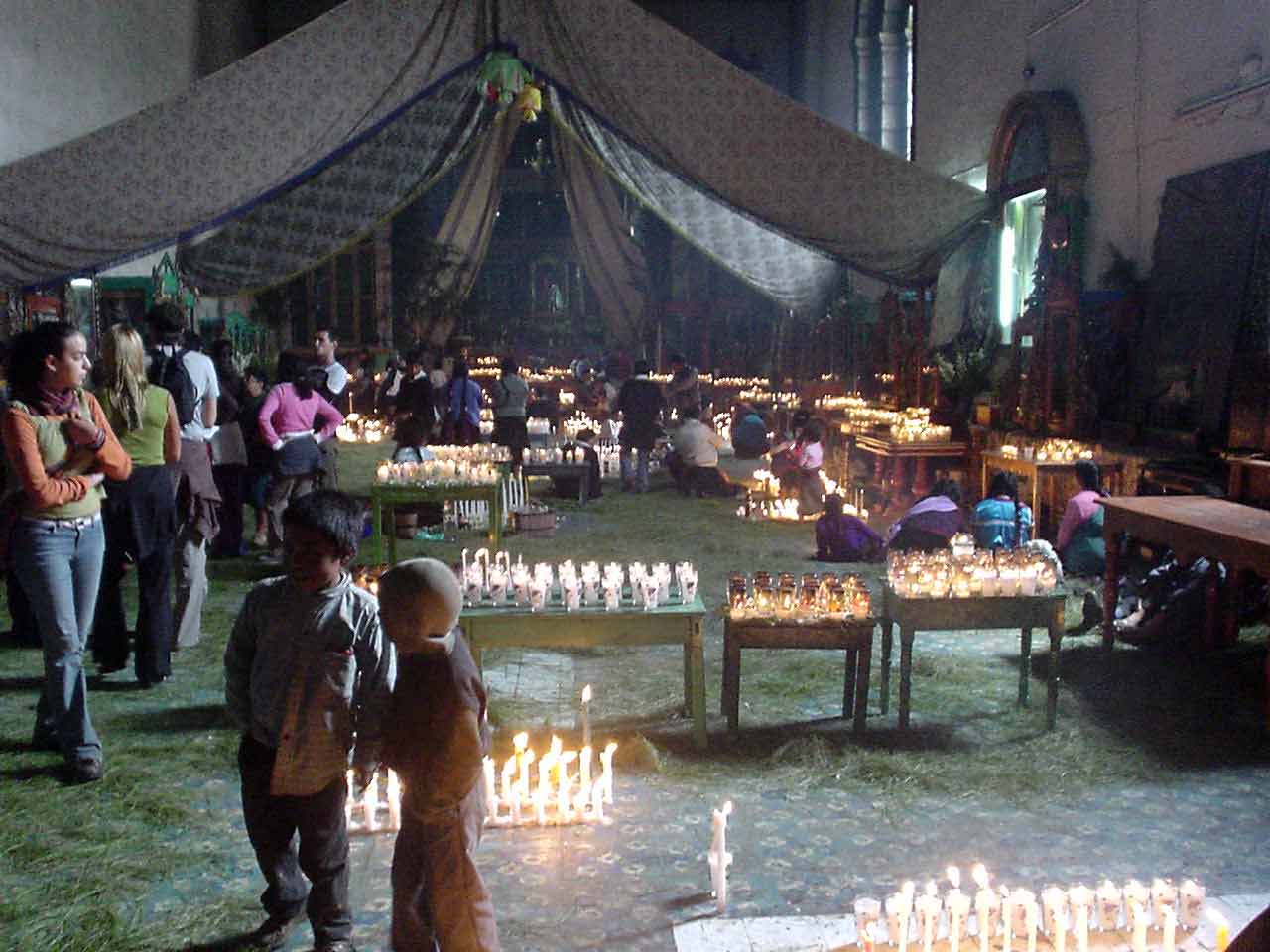
Syncretic worship in its interior (no photos are allowed inside but this came from an internet article)

They are very protective about this and stringently forbid photography inside the church, so here I managed to find an existing photo in an internet article on Chamulan worship to avoid the reputed beatings up of those who violate the restriction. The image above gives a very good impression of how we found it, except somewhat fuller with locals erecting complex arrays of candles of all kinds, to the extent that the church is full of the aroma of almost toxic levels of aromatics, while at the same time echoing with the refrains of many Mayan families singing out their devotions to the syncretic deities of Maya and Catholicism combined. The altar was in the process of being richly ornamented with fresh lilies and the floor was scattered with copious pine needles, making it utterly treacherous for one using crutches.

Panoramas of the church and town square (click to enlarge)


Otherwise the town has a slightly derelict, desolate appearance not lessened by the foreboding afternoon immanent rains, turning the day dark and full of heavy rain drops.

The church door illustrated with Mayan motifs

A Mexican girl sings Spanish songs to the Chamula children

The Chamulan scene has over the last couple of decades been riven by schisms between Catholicism, and converts to evangelical, Pentecostal and other forms of Christianity, partly associated with a rejection of the Catholicism of the dominant mestizo majority and also tied up with the Zapatista rebellion, resulting in the expulsions of many thousands of Chamulans, who now live in shantytowns on the outskirts of San Cristobal adding to their plight.

A sunnier internet view of the church

and the doorway

A Chamula man in black hairy coat on a market day

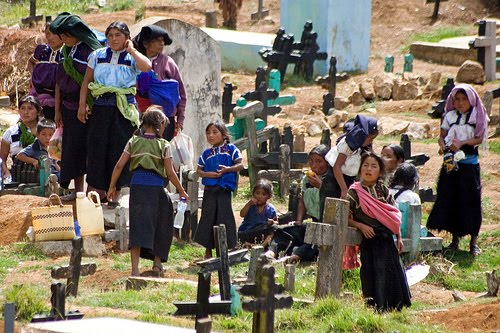
Two images of the Chamula graveyard


A Chamula woman in hairy skirt and traditional top in San Cristobal

I spent a lot of the time wandering the streets photographing the sights and people, with an interest in the variety of traditional clothing of the various Mayan and other peoples of Chiapas, so a number of the images are aimed to document the varieties of dress one could observe and catch in the short time we were here.

Chamula women street sellers with their wares

An old Chamula woman packing the Mayan dolls she sells at the end of the day

Left a Chamula woman and centre and right trditional floral garments now machine sewn


A woman wearing a huipil in red and purple designs

Older internet image of women at the Zocalo wearing similar huipils

Girls from the 40,000 strong Tojolabal-speaking Mayan community
near the Zocalo wearing their traditional costume

Street sellers wearing a variety of traditional costumes


Two elderly women

Chamula woman selling grass in the market

Two destitutes

Asleep in front of the grog